Showing posts with label History. Show all posts

Monday, June 27, 2016

Ozark Mountains lore and history

A highly recommended book by Joshua Heston, of Branson, Missouri.  

In The State of the Ozarks, Joshua Heston is following the footsteps
of Ozark folklorist icon Vance Randolph. With a keen eye and ear,
Joshua records the people and cultures of the Ozarks in a collection
of enjoyable and very readable essays.  In the Ozarks many aspects of
life have changed, but the basic character and roots of the Ozarkers
remain and we are fortunate to have Joshua documenting Ozark society
here in the twenty-first century.


The State of the Ozarks, Essays and Photos of the Ozark Mountain Region, by Joshua Heston


To purchase: The State of the Ozarks

Monday, October 26, 2015

William McIntosh Jr 1778-1825

McIntosh and Menawa

Real history is always more complex and multilayered than the history told by the modern media and even in most basic academic history books.  The relationship between the Scots-Irish and certain Indian tribes was complex.  The often were are war with one another, yet they also intermarried, made alliances, and lived together and shared the same values;  Clan, tradition, blood, a warrior culture, honour, were of paramount importance to both peoples.


William McIntosh Jr. 1778-1825

McIntosh

William McIntosh Jr. 1778-1825, also known as Tustunnuggee Hutkee (White Warrior), was born around 1778 in the Lower Creek town of Coweta to Captain William McIntosh, a Scotsman of Savannah, and Senoya, a Creek woman of the Wind Clan. He was raised among the Creeks, but he spent enough time in Savannah to become fluent in English and to move comfortably within both Indian and white societies.

He was a leader of the Lower Towns, the Creek who were adapting European-American ways and tools to incorporate into their culture. He became a planter who owned slaves and also had a ferry business. McIntosh was among those who supported the plans of U.S. Indian agent Benjamin Hawkins to "civilize" the Creeks. While McIntosh's support of white civilization efforts earned him the respect of U.S. officials, more traditional Creeks regarded him with distrust and contempt.

He was instrumental in the United States victory at the Battle of Horseshoe Bend. In the wake of that war, the Creeks suffered famine and deprivation for many years.  In 1825 cousins William McIntosh, a Creek leader, and George Troup, the governor of Georgia, signed the Treaty of Indian Springs, which authorized the sale of Creek lands in the state to the federal government. McIntosh allied himself with Indian agent David B. Mitchell, Hawkins's successor, to coordinate the distribution of food and supplies from the U.S. government to the Creeks. This alliance assured McIntosh's control over resources and he became a very wealthy man.

In 1821 the new Indian agent severed McIntosh's access to resources, weakening McIntosh's influence among the Creeks, who were then compelled to sell some of their land to pay debts and acquire food and supplies. However, for his role in the Treaty of Indian Springs, McIntosh received 1,000 acres of land at Indian Springs and another 640 acres on the Ocmulgee River. He himself owned two plantations with slaves, Lockchau Talofau (Acorn Bluff) in present-day Carroll County, and Indian Springs, in present-day Butts County.

McIntosh's participation in the 1825 Treaty of Indian Springs cost him his life. According to a Creek law that McIntosh himself had supported, a sentence of execution awaited any Creek leader who ceded land to the United States without the full assent of the entire Creek Nation. Just before dawn on April 30, 1825, Upper Creek Chief Menawa, accompanied by a large force over 100 Creek “Law Menders” (warriors), attacked McIntosh at Lockchau Talofau (McIntosh’s home and plantation overlooking the Chattahoochee River near Whitesburg, worked by 72 slaves and also served as a tavern and inn, owing to its location on the Federal Road and a strategic crossing of the river) to carry out the sentence.

They set fire to an outbuilding in order to light up the yard so as to prevent anyone from escaping. They called to the white guests and women to come out, saying they would come to no harm. McIntosh's son Chilly and another mixed-blood escaped from an outbuilding they were sleeping in because there wasn't room for everybody in the main house.

Shot in the front doorway of his home, McIntosh managed to climb the stairs to the second floor, from which he began shooting at his assailants. Forced to leave when they set fire to the house, he was shot and dragged some distance from the house. Raising himself on an elbow, he gave them a defiant look as he was stabbed in the heart. An eyewitness estimated that his corpse was shot about 50 times. After destroying what they could not carry away; slaves, horses, and cattle, produce, the assassins left.

Later that day they caught Samuel and Benjamin Hawkins, his sons-in-law and also signatories to the treaty. They hanged Samuel and shot Benjamin, but he escaped.

Menawa

Menawa (1765-1836), was second in command of the Red Sticks at the Battle of Horseshoe Bend in 1814, when they were defeated by General Andrew Jackson commanding militias of Tennessee, Georgia and the Mississippi Territory, as well as allied Cherokee. More than 800 Red Stick warriors died. Menawa was wounded seven times during the battle, but he escaped and survived his wounds. By his own account he lay among the dead until nightfall and then crawled to the river, climbed into a canoe, and disappeared into the darkness.

Some major Creek chiefs passed a resolution to kill McIntosh, and Menawa headed the assassination party. McIntosh was surrounded at his tavern on the old Federal Road in Georgia and shot to death.
By 1836 the Creek Indians had been repressed and were defeated a second time trying to save their ancestral lands. The U.S. was planning a general removal of the Nation. Menawa proposed that the Creek Nation give up their collective rights, though each individual who wanted to remain be given a plot of land. This proposal was defeated and the removal was commanded. Menawa had been given an exclusion from relocating by the U.S. but a local judge ordered him to join the exiles to the west.
Menawa reportedly stayed up all the night watching sunset and sunrise over his home Oakfuskee (located on the Tallapoosa River in present-day Alabama). As he joined his people traveling to an unknown place he said, "Last evening I saw the sun set for the last time and its light shine on the treetops and the land and the water, that I am never to look upon again."

Heartbroken, Menawa died on his way to the new Creek territory in the west. His burial place is now unknown. Menawa was not only brave and skillful, but was a gentleman in appearance and manners. Although he was a savage in the field, or in the revel, he could at any moment assume the dignity and courtesy proper to his high station. In after years, he regretted his role with the Creek Law Menders in 1825, saying that he would freely lay down his life, if by; so doing, he could bring back to life Billy McIntosh.

(credit:  John Stewart Longhunter Facebook page)


Wednesday, July 22, 2015

The Tomahawk, Scots-Irish Iconic Tool

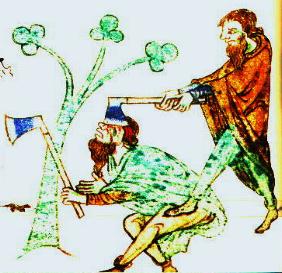
The humble hand axe, or tomahawk, is an iconic tool of the Scots-Irish.  It was the multi-tool of its day, of use around the camp for cutting, splitting wood, to drive stakes, and also used for personal protection.  It was good in hand to hand close combat and a skilled wielder could throw it with great precision at ranges from five to twenty yards.   While some associate it with the frontier, its design and use goes back several thousand years.


hand axe in war from a medieval Gaelic manuscript 


typical frontier tomahawk
Small hand axes, of the same design and type as used by the Scots-Irish on the frontier, were in use since prehistoric times in both Ireland and Scotland.  The battle axe was called a tuagh (said Too-ah) in Gaelic.  There are many hundreds of them in the Irish National Museum.  Early ones are in stone and as technology improved they were made in copper, bronze, iron, and eventually steel.  From their ethnogenesis in Scotland, to their migration to Ireland, and then to the frontier of the New World, the hand axe, or tomahawk, has remained the one constant of Scots-Irish material culture. It was the Scots-Irish frontiersman that introduced the American Indians to the tool.
deployed American soldier with tomahawk
 
The tomahawk is still very much in use today and is just as useful in the 21st Century as it was to our Neolithic ancestors.

Wednesday, May 20, 2015

Foyle Valley Covenanters, a new book by William Roulston


Dr William Roulston is the Research Director of the Ulster Historical Foundation. He holds a PhD in Archaeology from Queen’s University Belfast.


Foyle Valley Covenanters
In the middle of the eighteenth century a community of Covenanters in the Foyle Valley emerged from the shadows to form a congregation. The first minister was ordained in 1765 and six years later a site at Bready was secured for a meeting house. Since then the members of this small but significant congregation have been active in preserving a Reformed Presbyterian witness in the district as well as contributing to many other aspects of local life. Through a detailed study of the congregational and denominational records, this book explores the ministers and ministries, the life and work of the congregation, the buildings, the families, and the relationship between the Covenanters of Bready and the state. The appendices to the book include an index to the names in the earliest session book (1791-1800). Raised on the family farm in Bready, William J. Roulston grew up a few fields away from the Covenanter meeting house. He has written extensively on his local area and is the convener of the Reformed Presbyterian Church History Committee.

For overseas orders the best place to go is:

Sunday, March 1, 2015

The Kilt and the Scots-Irish

(note many Scots-Irish are of Argyll and Lennox ancestry, areas where the kilt was worn.  Of interest, the first detailed record of the kilt in use is from Ireland; an account of Redshanks arrived in 1596)


Is the kilt Irish…. was the kilt ever worn in Ireland? The answer to this question is a very simple yes, of course, but even simple answers need some explanation. The kilt comes in two forms, the filleadh beag and the filleadh mór. The wearing of kilts came into fashion in the Hebrides and Highlands of Scotland sometime during the late 1500s. Prior to the popularsation of the kilt most Isles and Highlanders dressed identical to the native Irish in a léine and short jacket.

Liam Neeson portraying Rob Roy wearing the large kilt, of filleadh mór

Why the kilt came into fashion can only be speculated on, perhaps it was the changing climate, which was growing colder in the late 1500s and the full kilt offered warmth, or perhaps it was improved small looms that could produce more woolen cloth, or perhaps just a fashion trend indigenous to the Gaels of Scotland. For whatever reason, the kilt became popular and fashionable among Gaels in certain parts of Scotland and would be brought to Ireland by Scottish Gaels that settled there in the late 1500s.

The filleadh mór is comprised of a very long piece of material called a plaid, which is belted in the middle. The upper part could be arranged in various ways depending upon the temperature of the day. The part below the belt was folded in the back to make pleats and came down to the knees.

There is a pseudo history about the creation of the smaller kilt, the filleadh beag, which is the form of kilt still very much in use today. At some point prior to 1690s, Gaelic tailors began to cut the filleadh mór in half. It was an organic fashion development within the Scottish Gaelic community. The upper part became a separate plaid and the lower part had the folds sown into it. This way the lower half, the kilt, could be worn separately from the plaid.


Sean Connery wearing the small kilt, or filleadh beag

A false story has long circulated about the creation of the small kilt that maintained two English tailors invented this form in 1727. However, in Gaelic oral history it was known that the small kilt predates this time. The English creation myth persisted in some circles until writer Clifford Smyth produced an illustration of the small kilt in use in 1690 and put an end to the pseudo history of the small kilt.


18th Century illustration on how to wear the kilt

In Ireland the full kilt and small kilt were worn in those areas settled by Highland and Hebridean Gaels. There are eyewitness descriptions of the kilt being worn as early as the 1590s in Ulster. Originally it was worn in the Redshank communities in east Donegal, northwest Tyrone, and north Antrim. Its popularity has waxed and waned over the years, but more and more the small kilt can be seen in Ireland worn at weddings and parties, by hill walkers, and sportsmen. This growing popularity of this very old Gaelic garment is natural and part of the heritage of Ulster.

Monday, February 16, 2015

Native Tribes of Britain

The majority of the Scots-Irish are descendants of the native Celtic tribes of north Britain.  Here is a link to an article on the BBC History website showing the location and names of these early Celtic tribes.

Link:  Native Tribes of Britain

Monday, October 27, 2014

The Cracker


Cracker Cattle


What is the etymology of the term Cracker?  We all know what a Cracker was (or is).  A Southern Anglo-Celt, usually of Scots-Irish origin, who lives in the backcountry.   The term appears intact and in use by the mid-1700s in Colonial America.  One eighteenth-century definition of what a Cracker provides a good description; in 1776 a Colonial official wrote to the earl of Dartmouth:

I should explain to your Lordship what is meant by Crackers, a name they have got from being great boasters; they are a lawless set of rascals on the frontiers of Virginia, Maryland, the Carolinas, and Georgia, who often change their place of abode.
They were basically a semi nomadic group who were excellent hunters, kept free range cattle and pigs, and lived in the backcountry.  They were normally of Ulster ancestry, but not exclusively so.

Cracker is still a much used term.  Dubious sources, such as Wikipedia, tell us it is a “usually derogatory term for white people.” Wikipedia also offers a proposed etymology of the term coming from the sound of the “whips” used by Southern whites on their livestock.
The real story is more complex.  It is term with links to Ulster and associated with the people we know as the Scots-Irish.  The original Crackers are also associated with free range cattle and lived in the backcountry.  That much is on firm ground, but the etymology is more difficult to deduce, but I believe is also linked to Ulster.  There are several possible origins, which I will not list and state each one’s case. 
Creachadóir:  This is the word I believe is the actual origin of Cracker. It is Ulster Gaelic and Scots Gaelic (Creachadair) word meaning, “raider and freebooter,” but also associated with the free range cattle drovers in Ulster.  In short, I think Cracker is the anglicised form of Creachadóir. 

Creach: (Ulster Gaelic) means a “herd of cattle,” and also a “Cattle raid.”   You will also find the word Greigh in Scot Gaelic meaning a “herd of cattle.”   There is also the Scots-Gaelic word Gréighear meaning a “farm grieve.”  (someone who took care of livestock) 
Other possible etymologies:

Cracaire: This word means “talker” or a person that chats a lot and is related to the modern Irish word “Craic” meaning “a gathering where people talk, have refreshments, and have a good time.”  As far as I can tell, the use of Cracaire and Craic are more recent in their use in the Gaelic language and I do not think this is the etymology of Cracker, but it is a debatable point.    

I think the salient element is the linking of Crackers to cattle.  Creach was anglicised as Creacht and was used from the mid-1500s into the early 1800s to describe both a herd of cattle and the drovers (cowboys) of the herd.  These men were also used for raiding parties.  So in actual use a Creacht was both a free range cowboy and raider and freebooter. In modern Gaelic usage the older meaning of free range cowboy has been dropped and now the definition is “raider and freebooter, ” but it was the same thing, or person, in a historical context.  So, in Ulster, we have the word Creach and Creacht in use in both Hiberno-English and Gaelic and meaning exactly what the Southern Crackers were.  Given the fact that the Crackers were from Ulster and were free range cowboys the Creach, Creacht, and Creachadóir, origin from Cracker is logical.
A Cracker Cowboy by Frederic Remington
The anglicised form may be from Creachadóir or it could be from Creach and anglicised from adding an English suffix of “er.”   I think however, the former more likely. 

So, the likely etymology of Cracker is from the Ulster and Scots Gaelic word Creachadóir.  For the record, Cracker is not considered derogatory among the Crackers living in the South today.  The opposite is true, it is an often used term of ethnic self-description and is a source of pride.  It means you are indigenous to the South, ancestors from Ulster or northwest Britain, have roots in the Uplands or Backcountry, are independent, self-reliant, you act in an honorable way, are good with weapons, hunting, fishing, and are man that knows how to do things.  As the Southern Crackers settled Texas and the Southwest they became the Cowboy, a cultural continuum of their unique lifestyle.   
Cowboy 1888

Monday, October 13, 2014

R-L21 Haplogroup and the Scots-Irish

 
Above is a map showing the location of the R-L21 Haplogroup.  R-L21 Haplogroup and the growing number of downstream (more recent in chronology) is the haplogroup of the majority of the Scots-Irish.  Historically it represents the 'Western Atlantic Celtic' population, which includes the Insular Celts, both Gaelic and Cumbric.   In layman's language, this population has it origins in the indigenous Celtic tribes of Britain and Ireland.  Within the Scots-Irish population this includes the native Cumbric Celtic tribes of what we now call the Scottish Lowlands, and the Gaelic population.  This tells us the majority of the people in the New World that identify as 'Scots-Irish' are the descendants of the indigenous Celts of the British Isles and Ireland.  (map is from the Eupedia website)

Friday, October 3, 2014

Texian Militia 1835


The Battle of Gonzales 2 October 1835


The Battle of Gonzales was fought near Gonzales, Texas, on 2 October 1835, between Texian settlers and a detachment of Mexican army troops. It was the first battle of the Texas War for Independence.  The majority of the Texians were Scots-Irish who had moved to Texas from Arkansas, Louisiana, Tennessee, Mississippi, and Alabama.

In 1831, Mexican authorities gave the settlers of Gonzales a small cannon to help protect them from frequent Comanche raids. During the ensuing four years, the political situation in Mexico deteriorated and in 1835 several states, including Texas, revolted.  Colonel Domingo de Ugartechea, the commander of all Mexican troops in Texas, requested the return of the cannon.

Design of the original Gozales flag

This request was refused and Ugartechea sent 100 dragoons to retrieve the cannon. The soldiers neared Gonzales on 29 September. The colonists negotiated with the Mexican troops but also sent messengers to request help from nearby communities. Within two days, up to 140 Texians gathered in Gonzales. On 1 October 1835, the Texian militia voted to fight rather than surrender their cannon.  The Texian militia was led by John Henry Moore, originally of Rome, Tennessee, who had settled in Texas in 1818.  Mexican soldiers opened fire as Texians approached their camp in the early hours of October 2.  The two sides exchanged fire for several hours, after which the Mexican troops retreated.

The skirmish marked a clear break between the colonists and the Mexican government and is considered to have been the start of the Texas Revolution. News of the skirmish spread throughout the United States, where it was often referred to as the "Lexington of Texas".

Modern version of the Gozales flag, still in use


Wednesday, October 1, 2014

Families in Londonderry, 1619-1800

SCOTS-IRISH ORIGINS, 1600-1800A.D.
GENEALOGICAL GLEANINGS OF THE SCOTS-IRISH IN COUNTY LONDONDERRY, IRELAND
PART THREE - ‘THE MAIDEN CITY’
THE INHABITANTS OF THE CITY OF DERRY / LONDONDERRY BEFORE THE SIEGE (c.1600-1688)


By Bob Forrest, B.A. Hons; Economic and Social History (Queen’s University, Belfast). 112 pages, over 2000 surnames
This is the third volume in the Scots-Irish Origins series. This volume focuses on the historic city of Derry/Londonderry in the seventeenth century and makes available a number of valuable and unique sources for the period.
The following seventeenth century records are included in this volume for the city of Derry/Londonderry:-
- the 1619 Inquisition,
- 1622 Muster Roll
- 1628 Rent Roll
- 1630 Muster Roll (599 names)
- 1642 Muster Rolls (9 companies)
- 1654/6 Civil Survey, 1659 Census
- 1663 Hearth Money Roll
- as well as numerous miscellaneous records including; Corporation records (Governors, Mayors, Aldermen, Sheriffs), lists of merchants and seamen linked to the port of Derry, Gravestone Inscriptions from the seventeenth century, siege records, Summonister (court) records (1611-1670), Will indexes (1600-1700), original will abstracts, and a list of Derry voters from 1697.

Link to Purchase:  Scots-Irish Origins


By Bob Forrest, B.A Hons; Economic and Social History (Queen’s University, Belfast). 112 pages, over 2000Inhabitants of Londonderry before the Siege surnames.
This is the third volume in the Scots-Irish Origins Series. This volume focuses on the historic City of Derry/Londonderry in the seventeenth century and makes available a number of valuable and unique sources for the period.

Derry is set in a beautiful location having been built on sloping hills set against the backdrop of the Inishowen mountains at a curve on the river Foyle and is one of the longest, continually inhabited places in Ireland with a record of monastic settlement dating from 545A.D. ‘The Derrie’, or ‘the oak-grove’, was an island area situated on the Foyle and became a settlement of strategic importance but remained an isolated outpost until the late sixteenth century. Sir Henry Dowcra’s military expedition, which arrived in Lough Foyle in May 1600, at the height of the Nine Years War, was instrumental in paving the way for the plantation of Ulster that began only a few years later under James I. After Dowcra, the British stayed in the northwest and by the early seventeenth century Derry had become a frontier settlement at the heart of the Ulster Plantation scheme.

The city was renamed Londonderry reflecting the involvement of the London Companies in the plantation of the county of Coleraine (also renamed Londonderry), and one of their obligations was to build a city at the site of Derry. The new planned city had an historic military function and extant muster rolls exist for the city for 1622, 1630 and 1642 and give indication of Derry’s origins as a garrison town. The city survived two sieges and repulsed all attacks during the seventeenth century. It was the resilience of Derry that largely ensured the survival of the Ulster plantation in the seventeenth century.

The purpose of this work is to identify the families and people resident in Derry in the seventeenth century, especially in the period before the siege. The colony planted by Dowcra was predominantly English in character but during the reign of James I increasing numbers of Scots from surrounding areas such as Rathmelton and Raphoe (Donegal) crowded into the new town searching for work. Trade links with Scotland were strong especially with the ports on the western seaboard. By 1630 Derry was the largest settlement in Ulster and had a population of 500 adult males and was similar insize to Boston, which in 1640 had a population of 1,200. In 1637, the surveyor-general of customs noted that the Scots heavily outnumbered the English in Derry. The rapid growth of the Scottish colony was remarkable and this is reflected in the surnames in the hearth returns for the city and liberties in 1663. By 1700 Derry had a population of over two thousand and the most impressive town in Ulster with its walls and regular street plan. Commerce was central to the life of Londonderry, which became a busy shipping port and this volume gives evidence of maritime, mercantile and craft elements present in the city in the seventeenth century.

Mr. Forrest has utilized a wide range of sources for this publication: Burgh records in Scotland, House of Common’s Journals, Calendar of State Papers, Calendar of Treasury Books, and the records from the National Archives of Scotland and the Public Record Office of Northern Ireland in order to identify the inhabitants of Derry and with over 2000 surnames this volume gives comprehensive listing of the inhabitants of the city before the siege.

The following seventeenth century records are included in this volume for the city of Derry/Londonderry:-
- the 1619 Inquisition,
- 1622 Muster Roll
- 1628 Rent Roll
- 1630 Muster Roll (599 names)
- 1642 Muster Rolls (9 companies)
- 1654/6 Civil Survey, 1659 Census
- 1663 Hearth Money Roll
- as well as numerous miscellaneous records including; Corporation records (Governors, Mayors, Aldermen, Sheriffs), lists of merchants and seamen linked to the port of Derry, Gravestone Inscriptions from the seventeenth century, siege records, Summonister (court) records (1611-1670), Will indexes (1600-1700), original will abstracts, and a list of Derry voters from 1697.
The following surnames can be found in this book:
ABBOT, ACORNE, ADAIR, ADAM, ADAMS, ADDERTON, ADDISON, ADAIR, ADARE, ADERTON, ADMISTON, AIKEN, AKENHEAD, AKINE, ALCORNE, ALEXANDERS, ALL, ALLAN, ALLANE, ALLECEN, ALLEN, ALLESTER, ALLEXANDER, ALLINE, ALLINSON, ALLYSON, ALSEN, ALSON, ANDERSON, ANDERTON, ANDROS, ANDROSS, ANKOR, ANKTILL, APLEN, APLIN, APLINE, APPLETON, AP-RICHARDS, APTON, ARBUCKELL, ARBUCKLE, ARCHER, ARCHY, ARCKETILL, ARDOCK, ARKWRIGHT, ARMSTRONG, ARTHUR, ASBURY, ASH, ASHBRIG, ASHE, ASHBURY, ASHDONE, ASHE, ASTRY, ATCHESON, ATCHISONN, ATKIN, ATKINSON, AUBERRY, AUSTEN, AVERELL, BABINGTON, BACON, BAILEY, BAGENALL, BAGNAL, BAGGS, BAKER, BAKON, BAILY, BAIRD, BALE, BALER, BALIFF, BALL, BALLARK, BALLAS, BALER, BALRIGE, BAMBRIDGE, BANCKES, BANKES, BAR, BARR, BARBER, BARKER, BARNARD, BARNES, BARNET, BARNSLY, BARR, BARRINGTON, BARRY, BARTLET, BARTON, BARWICKE, BASILL, BASLY, BASTARD, BATE, BATEMAN, BAUX, BAXTER, BAYLEY, BAYLY, BAYLYE, BEAMES, BEARDE, BEATY, BEAUMONT, BEAURIGE, BECK, BECKE, BEGARD, BEGGE, BEGGS, BELL, BEN, BENDENE, BENDERMAN, BENNET, BENEY, BENNETT, BENSON, BERESFORD, BERKETT, BERKELY, BERRY, BETSON, BEYLANDS, BICKERSTAFF, BINDINS, BINGLEY, BINGLY, BIRD, BIREY, BIRNE, BIRNIE, BISHOPP, BITROW, BIVES, BLACK, BLACKBORNE, BLACKBURN, BLACKE, BLACKER, BLACKHORNE, BLACKWELL, BLACKWOOD, BLAIR, BLAND, BLANY, BLUNDELL, BLUNKET, BOGG, BOGGE, BOGGES, BOGGS, BOHANAN, BOID, BOOTH, BORES, BOUGHAN, BOURKE, BOWEN, BOWSER, BOWYER, BOYD, BOYDE, BOYLES, BOYNE, BRABAZON, BRADIN, BRADY, BRAGG, BRAMPTON, BRAMSON, BRAMSTONE, BRARESHILL, BRASIER, BRAZIER, BRELLAHAN, BRICE, BRIDERS, BRIDEMAN, BRIDGES, BRIGHTE, BRIERS, BRIGHT, BRISSON, BROME, BROOKE, BROOKES, BROOKS, BROOME, BROSTER, BROWN, BROWNE, BROWNING, BRUNETT, BRUCE, BRYLAND, BUBBY, BUCHANAN, BURDINS, BULL, BULLACK, BURDIST, BURGESS, BURK, BURKE, BURLEIGH, BURLY, BURNES, BURNESIDE, BURNETT, BURNEY, BURNSIDE, BURNSYD, BURRELL, BURTON, BUTLER, BUTTON, BYAR, BYARS, BYERS, BYRES, CADE, CAHAN, CAHANE, CAHOWNE, CAIRNES, CAIRNS, CALBREATH, CALISE, CALDWELL, CALHOUN, CALLWELL, CALVEILL, CALWELL, CAMBELL, CAMBLE, CAMEL, CAMELL, CAMPBELL, CAMPIAN, CAMPSEY, CAMPSIE, CAMSY, CANNING, CANWELL, CAPP, CARBUT, CARIDGE, CARLETON, CARLILL, CARMIHILL, CARNES, CARE, CAREY, CARNES, CARR, CARRIGAN, CARRIGEN, CARRINGTON, CARSELL, CARSWELL, CARTER, CARY, CARYE, CASELL, CASKEY, CASON, CASSRONE, CASTELL, CECIL, CHADDOCK, CHALMERS, CHAMBERS, CHAPMAN, CHAPTMAN, CHESAN, CHETWOOD, CHICHESTER, CHILDS, CHILES, CHRISTUELL, CHRISTWELL, CHRISTYE, CHURCH, CLANTON, CLAPONE, CLAPP, CLARE, CLARK, CLARKE, CLARKSON, CLARSON, CLAVE, CLAYDE, CLAYTON, CLEGG, CLEID, CLEMENCE, CLEMENT, CLEMENTS, CLENAGHAN, CLINTON, CLOYD, CLOYDE, CLUIG, CLYDE, CLYTON, COALE, COATCH, COCHERAN, COCHERANE, COCHRAN, COCHRANE, COCKAYNE, COCKBARNE, COCKE, COCKEN, COCKENS, COCKER, COCKRAN, COCKRANE, COCKS, COGHERAN, COGHERON, COHOUNE, COLE, COLHOUNE, COLLINS, COLUINE, CONINGHAM, CONINHAM, CONLAY, CONNINGHAM, CONNOCK, CONNOR, CONOHER, CONOLLY, CONYNGHAM, COOK, COOKE, COOMES, COOP, COOPER, COOTE, COOTES, COPE, CORMACK, CORNHILL, CORNWALL, CORRION, CORRY, COTESMER, COTMORE, COTTESMORE, COTTISMORE, COTYMORE, COURTNEY, COVAN, COWAN, COWEY, COWPER, COX, COYLE, CRAFORD, CRAFFORD, CRAG, CRAGE, CRAGG, CRAGHEAD, CRAIG, CRAIGE, CRAKSHANK, CRACKSHANESSE, CRANE, CRANEEN, CRAVAN, CRAVEEN, CRAVEN, CRAYFORD, CRAYTON, CRAWFFORDE, CRAWFORD, CRESWELL, CROASE, CROFTON, CROFTS, CROKETT, CROMIE, CROOKESHANKES, CROOKESHANKS, CROOK, CROOKS, CROOKSHANK, CROOKSHANKS, CROSER, CROSS, CROSTS, CROW, CROWTHER, CRUICKSHANK, CRUKSHANKS, CUIN, CUISTION, CULBERSON, CULILAND, CUMMELL, CUNINGHAM, CUNINGHAME, CUNNINGHAM, CUNSTALL, CURIE, CURINGHAM, CURLING, CURLINGE, CURRY, CUST, CUTBERTSON, CUTHBERTSON, DALLAWAY, DANE, DANIELL, DANIELSON, DANY, DANYE, DAUIS, DAUISSON, DAVEY, DAVIES, DAVENPORT, DAVIS, DAVISON, DAVY, DAVYES, DAWBY, DAWLEY, DAWNAM, DAWSON, DEAL, DEALE, DECON, DELAP, DELAPP, DE-LAVIE, DE-LAVIS, DENNISON, DENNEY, DENNY, DENSYNE, DEVENNY, DICKES, DIGGS, DILLION, DINN, DIXON, DOAKE, DOBBIN, DOBBS, DOBSON, DODDINGTON, DOGHIRTY, DOLLMAN, DOLLWAY, DONELLAN, DONELDSON, DONELLSONN, DONNELSOM, DONNELSON, DORAN, DORNE, DOUGALL, DOUGHARTY, DOUGHERTY, DOUGLAS, DOUGLASS, DOUGLESS, DOUL, DOWAY, DOWDALL, DOWELL, DOWEY, DOWGALL, DOWNE, DOWNEING, DOWNES, DOWNING, DRAPER, DRIVER, DROSTER, DRUMMOND, DRURY, DUCE, DUDLES, DUGLAS, DUGLEISH, DUGLISH, DULAP, DULAPP, DUMBAR, DUNBAR, DUNBARR, DUNCAN, DUNKAN, DUNKIN, DUN, DUNBAR, DUNBARR, DUNN, DURDOK, DUTTON, DYKES, DYLLAN, EADIE, EARLS, EDGEWORTH, EDMONDS, EDMONSTONE, EDWARD, EDWARDS, EIDEN, ELDER, ELKES, ELLICOCK, ELLINGSWORTH, ELLIOT, ELLIOTT, ELLIS, ELVIN, ENALLRE, ENCHE, ENGLISH, ENICKSON, ERSKINE, ERWIN, ERWINE, ERWYN, ESPIE, EVANS, EVERS, EVERY, EVIN, ELVINE, EWEING, EWIN, EWING, EWRYE, EYERS, FANE, FAR, FARALD, FARBASCO, FARBET, FARGISHILL, FARMER, FARMES, FARQUHAR, FARR, FAULCONER, FENUY, FERGISON, FERGUSON, FERGUSSONE, FERRIER, FERRON, FERRY, FFINCH, FFOLLIOT, FFLANELL, FFLEMINGE, FFRANCKLAND, FRANKLINN, FFULTON, FILSELL, FINCH, FINDLAY, FINLEY, FINNIE, FINNSTON, FISHER, FIXTER, FLAVEL, FLEMIN, FLEMING, FLEMINGE, FLETCHER, FLEUILL, FOKER, FOLIOT, FOLLIOT, FOLLIOTT, FORGISSON, FORRESTER, FORSTER, FORSYTH, FORTESCUE, FORTISCUE, FORWARD, FOSTER, FOWELL, FOWLER, FOX, FOXLEY, FRAMPTON, FRAZIER, FREEBORNE, FREEMAN, FREMAN, FREN, FRENCH, FREWEN, FRIXTER, FRONDE, FUISH, FULLER, FULLERTON, FULLERTONN, FULTON, FUSHEY, FYNLEY, FYNLY, GAGE, GAINE, GAIT, GAJE, GALBEATH, GALBRAETH, GALBRAITH, GALLAGHER, GALLAUGHER, GALLOHER, GALTWORTH, GAMBELL, GAMBLE, GANNE, GARDELL, GARDENER, GARDINER, GARDNER, GARNET, GARY, GATE, GATES, GAULT, GAW, GAWLIAM, GAY, GEERING, GELVERY, GENIONS, GEORGE, GEVEN, GEYMES, GIBBON, GIBBS, GIBSON, GIBSONN, GIFFIN, GIFFINE, GIFFORD, GIFFORE, GIFFORDE, GILCHRIST, GILES, GILL, GILLASPY, GILKSONN, GILLER, GILLESPIE, GILLESPY, GILLIERE, GILLPATRICKE, GILLSONN, GILPATRICK, GILSONE, GIMBLE, GLADSTANES, GLASGOW, GLENN, GLOWRE, GLOVER, GOBURNE, GODBOLD, GODFREY, GODMAN, GOEBRETH, GOLDSMITH, GOLTERYE, GOODFELLOW, GOODWIN, GOODYEER, GOOSE, GORDON, GORE, GORGE, GORGES, GORMAN, GOTERY, GOTTERY, GOWEN, GRACE, GRAIDY, GRAFT, GRAHAM, GRAHAME, GRAHAMES, GRASSE, GRAUE, GRAVE, GRAVELL, GRAY, GRAYE, GREDINE, GREEN, GREENLEES, GREG, GREGG, GREGOR, GREHAMES, GRENE, GREYME, GRIFFE, GRIFFEN, GRIFFIN, GRIFFINE, GRIFFITH, GRIGSON, GRIMES, GRINSTEED, GRISKINGS, GRODYE, GROERTYE, GROFVENOR, GROVE, GROVES, GRYER, GRYMES, GUGHTREDGE, GUINE, GUNTER, GUTHERY, GUTHRYE, GUY, GWINE, GWYNN, GYLES, GYLLES, HAILE, HAIRE, HAIRES, HAIRS, HALL, HALLE, HALLEY, HALSHTON, HALTON, HAMAN, HAMBLETON, HAMEL, HAMELL, HAMIL, HAMILL, HAMILTON, HAMILTONN, HAMMILTON, HAMMILTOUNE, HAMMON, HAMMOND, HAMOND, HANAH, HANDASYDE, HANCOCK, HANDCOCK, HANDFORD, HANDLINGE, HANFORD, HANMER, HANKES, HANKOLY, HANNA, HANNOCK, HARCOUGH, HARDMAN, HARE, HARETOP, HARISON, HARISONE, HAROLL, HARPER, HARRAWAY, HARRINGTON, HARRISON, HARRYE, HART, HARTE, HARTT, HARTWELL, HARVEY, HARVYE, HARYSON, HARWOD, HASELLWOOD, HASTON, HAUGTEN, HAWARD, HAWKE, HAWKES, HAWKINS, HAY, HAYE, HAYDEN, HAYRE, HEA, HEARD, HEATH, HEATLYE, HEATON, HEGGARD, HEMSWORTH, HEMYN, HEARD, HEATH, HENDER, HENDERSON, HENDMAN, HENRICK, HENRY, HENRYE, HEPBOURNE, HEPBURNE, HERD, HERRIS, HERY, HEWAT, HEWESTON, HEYE, HILHOUSE, HILL, HILLE, HILLHOUSE, HINCKSONE, HINDEMAN, HINDMAN, HINKESON, HINSON, HOBSON, HOBSONN, HODGKINS, HOGG, HOLDING, HOLLAND, HOLMES, HOME, HOMESONN, HONE, HONEY, HOODE, HOPKINS, HOPPON, HORN, HOROSTON, HOSLOCKE, HOUGHTON, HOULE, HOUSE, HOUSELOCK, HOUSTON, HOUSTONE, HOUSTONN, HOW, HOWE, HOWELL, HOWARD, HOWESON, HOWESONN, HOWTON, HOYLE, HUCHESON, HUDCEN, HUDSON, HUDSONN, HUES, HUEY, HUFTON, HUGHES, HULLS, HULLYE, HUMBESTONE, HUMES, HUNT, HUNTER, HUNTERHURD, HUSCOCK, HURST, HUSTON, HUSTONE, HUTCHISONN, HUTCHON, HUTSON, HUSTONE, HUTTON, HYNDMAN, HYNES, HYNN, INCHE, INGLIS, ISLEN, IRISH, IRWIN, IRWYN, JACKARD, JACKET, JACKSON, JACKSONN, JACON, JAMESON, JAMISON, JEFFRYS, JEFFS, JEMMET, JENKIN, JENKINE, JENKINES, JENNINGS, JENNINS, JENNY, JEREMY, JOANES, JOHNES, JOHNSON, JOHNSTON, JOHNSTONE, JONES, JORDAN, JOURDEM, JOURDAN, JOURDEN, KADWALLADER, KANAN, KANE, KANNE, KARR, KEAN, KEARNS, KEAWORTH, KEELAND, KEENE, KEILE, KELLY, KELLYE, KENDRICK, KENEDYE, KENNEDY, KENNY, KENRICK, KENWOOD, KER, KERBYE, KERKE, KERNES, KERR, KETLEBYE, KEYES, KEYLE, KEYMYN, KEYS, KIDEL, KILL, KILNER, KILPATRICK, KINASTON, KING, KINGE, KINGSTON, KINKAIDE, KINKEAD, KINNISTON, KIRBY, KIRK, KITCHINE, KITWALLADER, KNEALAND, KNEELAND, KNELAN, KNELAND, KNIGHT, KNOBBS, KNOBS, KNOCKS, KNOTT, KNOWELS, KNOWLES, KNOX, KYLE, KYLL, KYLLE, KYNASTON, KYNG, LABAL, LABE, LACI, LAMAN, LAMKIN, LANCE, LANE, LANG, LANGEMORE, LANGFORDE, LANGMORE, LANGTON, LAPSLEY, LARGE, LASON, LATHAM, LATHEM, LATHUM, LATHUN, LAULIN, LAULY, LAUTY, LAVEY, LAWE, LAWRENCE, LAWRY, LAWSON, LAWSONN, LAWTIE, LAWTON, LAYON, LEA, LEACH, LEACHEN, LEAKE, LECKY, LEAP, LESTON, LEATHEM, LECKIE, LECKY, LEDIAT, LEE, LENEN, LENOX, LENNOX, LENRY, LERGE, LESLIE, LESLY, LESTON, LEWIS, LEY, LIDSUM, LINDSAY, LINDESAY, LINDSEY, LINDSEYE, LINNE, LITROW, LOGAN, LOGG, LOGGAN, LONE, LONG, LONGE, LOUGH, LOUGHEAD, LOUTHER, LOW, LOWRIE, LOWRY, LOWTHER, LUCAS, LUNDIE, LUNDY, LYN, LYNDSAY, LYNDSIE, LYNN, LYNNE, LYNTON, LYON, MACBELLANE, MACCABRID, MACCHIRKSON, MACCLAIE, MACCLELAND, MACCLOUKES, MACCONNELL, MACCORKILL, MACCORRIGAN, MACCREE, MACGENNLY, MACGORE, MACGORMLEY, MACGROGERTY, MACGRORTY, MACGOWNE, MACK, MACKAY, MACKEY, MACILCONNEL, MACKENNLIE, MACKENZIE, MACKIE, MACKILDUFF, MACKILLNEY, MACKINNEY, MACKINNY, MACLAGHLIN, MACLCONNEL, MACKMATH, MACKRERY, MACKRONE, MACQUIGLEY, MACLOGHLIN, MACNICHOL, MACCOLLOGH, MACONAHYE, MACOWELL, MACPHETRIX, MACSWINE, MACAULY, MACWARD, MADDAN, MADER, MADERELL, MADERNELL, MADLEY, MADOX, MAGEE, MAGHLIN, MAGOWEN, MAGOWNE, MAINE, MAIOR, MAIRE, MAJOR, MAKAYE, MAKEE, MAKEIR, MAKENNIS, MAKEYE, MAKIM, MAKING, MAKKAY, MAKLANE, MALCOLLUM, MANBY, MANESFIELD, MANESOOTH, MANSFIELD, MANSON, MARCEY, MARDOCK, MARE, MAROW, MARROW, MARSDEN, MARSH, MARSHALL, MARSTONE, MARTIALL, MARTIN, MARTINE, MASON, MASTERS, MATGINSEY, MATHEW, MATHEWES, MATHREWES, MATTHRO, MATIRE, MAULAN, MAXFIELD, MAXWELL, MAY, MAYOR, McARTAN, McBOYLE, McBREAN, McCACLES, McCALLAN, McCAMUL, McCAMUS, McCAN, McCARKAN, McCARMICK, McCARRUNGALL, McCARTHY, McCAVERE, McCAWLEY, McCAY, McCARRELL, McCLELLAND, McCLELLANY, McCLENAGHAN, McCOLE, McCOLLON, McCOMBE, McCONNELL, McCONOGHIE, McCORBE, McCORDALL, McCORMICK, McCOWAN, McCRACKEN, McCREE, McCULLOCH, McCULLOGH, McCUTCHEN, McCUTCHEON, McFFARLAN, MACFETRIDGE, McGEE, McGIMPSY, McGILL, McGILLBREEDY, McGILLIGAN, McGLOON, McGOWEN, McGUNN, McILLCOYLL, McILDUE, McILLDUFFE, McILTEGART, McKANLY, McKEE, McKEENE, McKENLEN, McKENLY, McKENNEY, McKENNY, McKER, McKEROGE, McKEY, McKEYNE, McKILCOME, McKILCRONE, McKILDUFFE, McKILTIRE, McKINNILEY, McKNOB, McLANLIN, McLEALAND, McLENTOG, McLOCHIN, McLOCKIN, McLOGHLIN, McLORNANE, McMAISTER, McMATH, McMISH, McMURRIN, McNARE, McNEAL, McNICOLL, McNILL, McROARTY, McRUDEN, McRUTTER, McSHADDEN, McSWINE, McWALLER, McWILLY, MEARE, MEDCALFE, MELL, MERCER, MERSTOUN, MERVYN, MERYWEATHER, MESSENGER, METLAND, MICHAEL, MICHELBURN, MICHELL, MILL, MILLER, MILLES, MITCHEL, MODERWELL, MOGRIDGE, MOLDRAGE, MOLLCHELLIN, MOLLINE, MONCREIFE, MONCRIEF, MONCRIEFF, MONCRIFF, MONKTON, MONNELL, MONRO, MONROE, MONROW, MONSERRANCE, MONT, MONTGOMERY, MONTGOMMERY, MOOR, MOORE, MOOREHEAD, MOOTE, MORDOCK, MORDOCKE, MORE, MORGAN, MORGES, MORE, MORGIN, MORISON, MORRICE, MORRIS, MORRISON, MORRISONN, MORROW, MORTHWAN, MOSSOM, MOULES, MOUNT, MOUSEROUN, MULHOLLAND, MULLAN, MUNDAY, MUNGOUMERYE, MUNNDLY, MUNNELLY, MUNROE, MURDOCK, MURE, MURPHETT, MURRAY, MURREY, MUTTERWELL, NAPPER, NAUGHTLEY, NEALE, NEALSON, NEELY, NEESBIT, NEILE, NEILSON, NELLAURE, NENMO, NESBIT, NESBITT, NESMITH, NEVILL, NEVILLE, NEVIN, NEWBURGH, NEWCOMB, NEWCOMEN, NEWEN, NEWMAN, NEWTON, NEWTOWN, NEWTOWNE, NICHOLS, NICHOLSON, NICHOLSONE, NICOLLSON, NIGHTINGALE, NILLEN, NISBET, NIXON, NOBLE, NORDE, NORMAN, NORRIS, NORY, NOTTRICE, NUTT, OBERY, O’BOWELL, O’BOYD, OBRE, O’BRELY, OBREY, O’BROLY, O’BYYNE, O’CANE, O’CAHAN, O’CAHN, O’CANAN, O’CANE, O’CANNAN, O’CATHAN, O’CHANE, O’CREVELLIN, O’CURRAN, O’DAYRE, O’DERMONT, O’DERRY, O’DEVENNY, O’DOGHERTIE, O’DOGHERTY, O’DOHERTY, O’DOHERTYE, O’DONNELL, O’DOWE, O’DREY, O’DURRYE, O’FENEY, O’GALLOGHER, O’GALLOHER, OGLE, O’GORMAN, O’GOWN, O’HAGARTIE, O’HAGARTY, O’HALLEY, O’HARKAN, O’HARLEY, O’HAVELAND, O’HEGARTIE, O’HEGARTY, O’HENRY, O’KEAN, O’KELLY, O’KELLEY, O’KINE, O’LAFFERTY, O’LANCARIE, O’LANIE, O’LASHEYE, O’LASHYE, O’LENERICK, O’LAULIN, O’LECKYE, OLFARDS, OLFEARD, OLFERT, O’LINE, O’LINSHANAN, O’MAULEY, O’MULLAN, O’NEAL, O’NEALE, O’NEIL, O’QUIGLEY, O’QUSTION, ORE, O’REALL, O’REGONE, ORNEAL, ORNELL, ORRELL, O’RELY, O’RENE, O’REYNE, ORMSBY, ORNOYLE, ORR, O’RODDEN, O’RYLIE, OSBORN, OSBURN, OSBORNE, OSBOURNE, O’SHEALE, O’SHEIL, O’SHENE, O’SHENKYE, O’SHERINE, O’SREAN, O’STEENE, O’STINE, O’STREENE, O’TAMENNY, O’TOY, OWENS, OWINS, PACKER, PACY, PAINE, PALMER, PARDEN, PAREY, PARKE, PARKER, PARKE, PARKER, PARKES, PARKS, PARSEY, PARSONS, PARTLET, PASLEY, PASSY, PATERSON, PATSHALL, PATSON, PATT, PATTERSON, PATTESHALL, PATY, PATYN, PAWLETT, PAYNTER, PERCY, PEAREMAN, PEARMAN, PEARSE, PEIRMON, PEIRSON, PERCEE, PENMAN, PEOPLES, PERPOYNT, PERRY, PETFEILD, PETT, PHETIS, PHILIPS, PHILLIPS, PICKARD, PICKIN, PIEMONT, PIERCE, PIERSON, PIGOT, PIGOTT, PILOT, PINKERTONN, PIOTT, PIREY, PIT, PITS, PITT, PITTS, PLATT, PLOTT, PLUNKET, PLUNKETT, POAGE, POAKE, POCK, POCKE, POGE, POKE, POLKE, POLLOCK, PONSONBY, POOK, POOKE, POOLIE, POOLE, PORTER, POTTS, POULTENEY, POULTON, POWELL, POWER, PREINT, PRENT, PRICE, PRIDION, PRIGEON, PRITTIE, PRITTY, PROPTER, PRYCE, PURDIE, PURDON, PUSTYE, QUALANE, QUANTAIN, QUIGGE, QUIGLEYE, QUIGLY, QUINTON, RABB, RAGSTON, RAILEY, RAIMAR, RAIMONDE, RAINEY, RAKNE, RAMESE, RAMIR, RAMSAY, RAMSEY, RAMSEYE, RANALDS, RANDALE, RANDLE, RANDOLL, RANICK, RANKEN, RANKIN, RANKINE, RANNELL, RANNELLS, RATCLIFFE, RAVEN, RAWDON, RAY, RAYE, RAYMON, RAYSDALE, REA, READ, READALL, READE, REALLY, REDDALL, REDGATE, REEDE, REIVES, RENEY, REYNOLDS, RICHARDE, RICHARDS, RICHARDSON, RICHARDSONN, RICE, RICHE, RICHER, RICHERSON, RICHEY, RICKEARDS, RICHMAN, RIDDAL, RIDDELL, RIDLEY, RILE, RINDE, RIPLEY, RISE, ROBACK, ROBERTON, ROBB, ROBENSON, ROBERT, ROBERTES, ROBERTS, ROBERTSON, ROBINS, ROBINSON, ROBINSONE, ROBISON, ROCHE, RODGER, RODGERS, ROE, ROES, ROGER, ROGERS, ROLE, ROOIN, ROOTELIDGE, ROSE, ROSS, ROSSAL, ROSSE, ROWAN, ROWAT, ROWE, ROWLEY, ROYD, ROYDE, ROYLY, RUDD, RUDDALL, RUDDEN, RUDDOCK, RUDE, RUDLE, RUE, RULE, RUSSELL, RUST, RUTTER, RYFORD, SACKFEILD, SADLER, SADOCK, SAMPSON, SAMPSONE, SAMSON, SANDELAM, SANDERS, SANDERSON, SANDYES, SANKEY, SAUNDERSON, SAVAGE, SCAMMON, SCOLLERS, SCOT, SCOTT, SCRIMGEOUR, SCRIMSEOUR, SEAR, SEARES, SEATON, SEMPILL, SEMPLE, SEYNTLOWE, SHANNON, SHARER, SHARPE, SHAW, SHAWE, SHELCROSS, SHELDON, SHELSHELTONN, SHERBY, SHERHARD, SHERINGTON, SHERLEY, SHERRARD, SHERRINGTON, SHERWOOD, SHEVINGTON, SHIRLOCK, SHOBURNE, SHORT, SHORTIDGE, SHREIFFE, SHURSBY, SIDBERT, SIDENHAM, SILL, SIMCOKE, SIMKINS, SIMPLE, SIMPSON, SIMS, SIMSON, SINCLAIR, SKAMON, SKEFFINGTON, SKELTON, SKERLET, SKEVINGTON, SKIFFINGTON, SKINER, SKINNER, SKIPTON, SKIPTONN, SKOT, SKYNNER, SLAMMON, SLATTER, SLATER, SLAUGHTER, SLEMON, SLOANE, SLONE, SLUANE SLURGEN, SMELLY, SMETY, SMITH, SMYTH, SMYTHE, SOLLERS, SOUTHERY, SPAN, SPARKES, SPARKS, SPEARE, SPENCER, SPIKE, SPREWELL, SPRINGHAN, SPROUSE, SPRUEL, SQUIRE, SQUIRL, STANHOPP, STANLEY, STANSBY, STAPLES, STARRET, STAYNE, STEEL, STEELE, STEENSON, STEILE, STENSON, STENSONN, STENSONNE, STERLINGE, STEVENSON, STEVSON, STEWARD, STEWART, STERLING, STEYNINGS, STILES, STILLYE, STINNSON, STINSON, STOCK, STOKKES, STOTESBURY, STRABRICK, STRABRIDG, STRANGE, STRINGER, STROBRIDGE, STRONG, STROUD, STUART, STUDDALL, STYNSON, SUTTON, SWAN, SWEATENHAM, SWEETNAM, SWOORLEY, SWYNE, SYD, SYMKINS, SYMONDS, SYMPSON, TACKETT, TAILZIOR, TAIRE, TALLEN, TALLON, TARBUTT, TARE, TARLETON, TASH, TATHE, TAYLOR, TEMPLE, TEMPLETINTON, TERRE, TERRY, THOMAS, THOMPSON, THOMSON, THORNTON, THORPE, TIFFANY, TINNEY, TOLLER, TOMKINS, TOMPSON, TOMPSONN, TOMSON, TOMSONE, TOOCKEY, TOPINE, TORESYTH, TOUCH, TOWERS, TOWNHAM, TOWNSEND, TOXONE, TOYDEN, TRACEY, TRACY, TRAICY, TRAPE, TREVERSE, TREVONE, TREVOR, TROWAN, TRUEMAN, TRUMAN, TUBMAN, TUCKER, TUCKEY, TURBAT, TURBET, TURBETT, TURNER, TYSE, UINSON, UPTON, VADELEY, VAIL, VALE, VAUDRY, VAUGHAN, VEASIE, VEASOY, VENABLES, VERETT, VERNOR, WADEN, WALDER, WALKER, WALL, WALLACE, WALLAS, WALLICE, WALLY, WALSH, WALTERS, WALTHAM, WANDERFORD, WARDE, WARDEN, WARDNER, WARDREN, WARNER, WARNET, WARREN, WASSEN, WASTLE, WATMOUTH, WATS, WATSEMON, WATSON, WATSONN, WATSONNE, WATT, WATTS, WAYNEMAN, WEBB, WEEKS, WEIR, WELL, WELLINGTON, WELLS, WELSH, WENDESFORD, WENNYS, WELSH, WESBY, WESCOINGE, WESGATE, WESSCOAT, WEST, WESTCOTE, WESTE, WESTGATE, WESTOCK, WESTON, WETHEROWE, WHALEY, WHARON, WHEADON, WHISTLER, WHITE, WHITEWELL, WHITLOE, WHITNEY, WHITTAKERS, WHITTLE, WHITWELL, WHYTE, WIGTOWN, WILDE, WILDRAGE, WILKINE, WILKINS, WILKINSON, WILL, WILLEMSON, WILLAGE, WILLIAM, WILLIAMS, WILLIAMSON, WILLINGTON, WILLIS, WILLSON, WILLSONE, WILLSONN, WILLYE, WILSON, WILSOUN, WINSLOW, WITAKER, WOLDREDG, WOLRIDGE, WOOD, WOODS, WOODSIDES, WOOL, WOOLL, WOOLDNEY, WOODES, WOODROSE, WOOLLEY, WOORK, WORKMAN, WRAY, WRAYE, WRIGHT, WURRAL, WYLDE, YALE, YARBAR, YARBOROY, YARBORROWE, YERBOREY, YORKE, YONGE, YOUNG, YOUNGE, ZACHARY

Monday, September 29, 2014

Scottish historian Tim Clarkson

This blog is primarily about the Scots-Irish in the New World from Colonial times to the present.  Occasionally, I will post items of interest concerning the history of the Scots-Irish prior to their migration to the New World.  Below is a link to the blog of Scottish historian Tim Clarkson, who is a leading researcher concerning early medieval Scottish history.  It is highly recommended.

Link:  Seanchus

Wednesday, July 16, 2014

The Great Wagon Road

The Great Wagon Road followed paths used by Indians and was the main roads by which the Scots-Irish moved south and west and peopled the backcountry and Southern Uplands.  In the 1700s and early 1800s The Fall Line Road and Upper Road became the most used segments of the road system and many Scots-Irish settlements were established along these routes from Pennsylvania to Georgia.
(Map from the book 'Map guide to American migration routes, 1735-1815'  by William Dollarhide.)

Wednesday, June 18, 2014

Scots-Irish DNA Project Update 18 June 2014

Of this morning, the project has 384 families participating.  The results page is current and most kits have been grouped by haplogroup designation.  As many know, Family Tree recently expanded and revamped their haplogroup nomenclature and added many new designations.  On the results page the kits are listed under both the shorthand and full haplogroup name.  For those members that have tested various SNPs this has the potential for providing a lot of new data for your family history.

The geneticists are identifying more haplogroups downstream from the major groups. This will allow us to classify kits with more precision.  The end result is your kit will be in a haplogroup from a more recent genetic event.  In layman's terms, it will allow you to locate your family's geographic point of origin and identify your kinship group in historical times.  For Scottish origin families this is particularly useful information. (that clan and blood thing)

Many of the kits in the major haplogroups such as R-M269 or R-L21 would benefit from testing for downstream SNPs.

Some analysis of the Scots-Irish: 

The majority of the participants are as expected of Atlantic Zone Celtic origin. This will be a combination of Cumbric and Gaelic Celts native to Scotland.  The participants are running about 65% of Lowland Scottish origin and 35% Highland Scottish origin,.  There is a stereotype of all Scots-Irish being from 'the Lowlands' but many were from Argyll and Lennox in the southwest Highlands. This is showing up in the DNA results.

One interesting aspect, we have more I haplotypes than expected.  Some of these I subgroups are Scottish Norse/Norman in origin and others are indigenous to ancient Scotland.  It is a very complex group and I have not had time to read the latest research on the I subgroup origins.  We are dealing with a lot of very new material.

I highly recommend the books 'Britain Begins' and 'Celtic from the West 2' by Dr Barry Cunliffe for those who would like to read the latest research and thinking about the people who became the 'Scots-Irish.'   

Monday, March 31, 2014


The shaded areas in the map above show where Scots-Irish settled and became the dominate ethnic group.  These areas also represent where Scots-Irish are still found in large numbers in the 21st Century.  The Appalachian area contains a core Scots-Irish area and runs from West Virginia down to the Mississippi Hill Country.  There are two other core Scots-Irish areas, east Texas and the Arkansas mountains, both the Ozarks and Ouachitas.

Thursday, March 27, 2014

The Goliad Massacre

On 27 March 1836, some 342 Texan soldiers were executed by the Mexican army in what would be known as the Goliad Massacre.  This was in the opening phase of the Texas War for Independence. The majority of the Texican soldiers were Scots-Irish.  Many of the settlers in Texas were from Alabama, Mississippi, Louisiana, Tennessee, and Arkansas and predominately Scots-Irish.


Troutman Goliad Flag

Above is one of the flags used by Texican troops at Goliad.  The single star flag had been used by Scots-Irish people since 1810. 


Link to roster of Texican soldiers at Goliad:  Colonel James Fannin's Command

Tuesday, March 25, 2014

Battle of Horseshoe Bend 27 March 1814


Americans troops circa 1814
A very famous day in Scots-Irish history is 27 March which is the anniversary of the Battle of Horseshoe Bend.  On this day in 1814 General Andrew Jackson led force consisting of 2,600 American soldiers, 500 Cherokee, and 100 Lower Creek allies to attach the Red Stick Creek fort  defended by 1,000 warriors on Horseshoe Bend on the Tallapoosa River.  The majority of Jackson’s men were Scots-Irish.

The battle began in full at 10:30 that morning with an artillery barrage which consisted of two cannons firing for about two hours.  However, the Red Stick Creek fort was expertly constructed of heavy timber and earth.  Very little damage was done to fortifications and the Red Stick Creek were entirely safe and well supplied behind their walls.
 
Horseshoe Bend today
Jackson ordered a bayonet charge and the 39th US Infantry led by Colonel John Williams charged the breastworks and engaged the Red Sticks in hand to hand combat.  Sam Houston was an officer that participated in the battle.  He distinguished himself greatly; he was the first man to survive going over the log barricade into the Red Stick lines.  He was wounded by an arrow, a wound that troubled him the rest of his life.  David Crockett was a scout for Jackson’s army, he was scouting when the engagement took place, and while was in the vicinity, did not participate in the fighting of that day.   

More of Jackson's army under General John Coffee crossed the river and joined in the battle.  The fighting was extremely intense and lasted over five hours.  Eventfully Jackson got the upper hand and the Red Stick defenses collapsed.  The Red Stick losses were heavy, between 800 to 1000 dead.  Their Chief, Menawa, was wounded, but survived and led a party of his warriors across the river to safety and escaped to Spanish Florida.  The Scots-Irish losses were between 30 to 40 killed and around 150 wounded. The victory made the area safe for the Scots-Irish settlers.

Saturday, March 22, 2014

The Laggan Redshanks

Mongavlin, the Castle of Iníon Dubh


 In the sixteenth century Scottish Highlanders settled in the Laggan district of east Donegal. They were called Redshanks.  The history of the Laggan Redshanks has many fascinating elements which include Clann Chaimbeul and their dynamic leader the fifth Earl of Argyll, Gaelic sexual intrigues, English Machiavellian manoeuvres, and the Redshanks themselves.  This book not only tells the fascinating story of how a Highland Scottish community became established in the Laggan, but also includes the surnames of the Redshanks and notes of their origins in Scotland, which will be of interest to family historians and genealogists.
 
This book has the complete Portlough Muster roll taken in 1630 and includes notes on each of the surnames.  It is available from Amazon as a paperback and Kindle version.

Link to Amazon:  The Laggan Redshanks

I have been asked many times about Highland Scottish surnames among the Scots-Irish.  Over the years as I worked with primary sources I did indeed notice within early Scots-Irish settlements there was a considerable Highland Scot presence.  One part of the story concerns the migration of Highlanders from mid-Argyll and Lennox to east Donegal circa 1569 to 1600.  This migration was sponsored by Clann Chaimbeul.  After the Plantation began in 1609 these Highlanders remained on their lands in the Laggan district.  Their experiences with the New Order in Ulster was different than other Redshank (Highland Scots) communities living in Ireland.  One reason was these particular Redshanks were of the Reformed faith.  Clann Chaimbeul, under the fifth Earl of Argyll were early converts to the Reformed faith.  While they retained their Gaelic language and culture they did in time become part of the general Ulster Scots community in the Laggan. When the Ulster Migration began in 1718 they were on the first ships that left for the Colonies and throughout the eighteenth century they continued to migrate in great numbers.  In the New World they were part of the people that became what we call today, the Scots-Irish.    
 

Wednesday, September 4, 2013

Donagheady Parish County Donegal

If you have ancestors from County Tyrone, Three centuries of life in a Tyrone parish. A history of Donagheady from 1600 to 1900, by Dr William Roulston is an excellent book for not only family history and genealogy research, but also to better understand life in that part of Ulster. This book is highly recommended.


This book tells the story of the parish of Donagheady and its families over three centuries. Donagheady occupies the most northerly portion of County Tyrone. It is a large parish, stretching from the River Foyle to the Sperrins. In the period covered by this study Donagheady experienced massive changes with the result that the parish in 1900 was a very different place from the one it had been in 1600. Through the Plantation and subsequent waves of migration in the seventeenth century, especially from Scotland, the character of much of the parish was transformed.

The creation and disintegration of the estate system in Donagheady is also charted in this volume and the fate and fortunes of the landowning families and their tenants is explored. The histories of the main religious denominations are covered, as well as the nature of rural society itself. Other chapters in this book examine the impact of the Great Famine on the parish, the development of the village of Dunnamanagh, attempts to improve educational provision, the rise and decline of rural industries, and the relationship between Donagheady and the wider world.

William Roulston is from the townland of Gortavea in the parish of Donagheady, and was raised on a farm that has been in his family’s possession since 1830. He is the Research Director of the Ulster Historical Foundation. His other books include The parishes of Leckpatrick and Dunnalong: their place in history (2000), Researching Scots-Irish Ancestors (2005), and Restoration Strabane, 1660-1714 (2007).

Link to purchase Ebook format:  Three Centuries of Life in a Tyrone Parish. A History of Donagheady from 100 to 1900.