Saturday, July 25, 2015
McCain's Corner: Anglicized Surnames; the many forms of John
McCain's Corner: Anglicized Surnames; the many forms of John: Knowing the Gaelic form of our surnames is a very helpful in genetic genealogy research. There are many surnames in Ireland and Scotla...

Wednesday, July 22, 2015
The Tomahawk, Scots-Irish Iconic Tool
The humble hand axe, or tomahawk, is an iconic tool of the
Scots-Irish. It was the multi-tool of
its day, of use around the camp for cutting, splitting wood, to drive stakes,
and also used for personal protection.
It was good in hand to hand close combat and a skilled wielder could throw
it with great precision at ranges from five to twenty yards. While some associate it with the frontier,
its design and use goes back several thousand years.
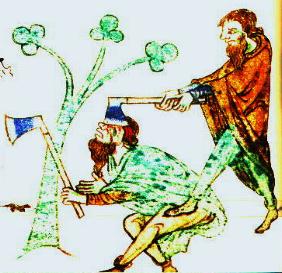 |
hand axe in war from a medieval Gaelic manuscript |
 |
| typical frontier tomahawk |
Small hand axes, of the same design and type as used by the
Scots-Irish on the frontier, were in use since prehistoric times in both
Ireland and Scotland. The battle axe was
called a tuagh (said Too-ah) in Gaelic.
There are many hundreds of them in the Irish National Museum. Early ones are in stone and as technology
improved they were made in copper, bronze, iron, and eventually steel. From
their ethnogenesis in Scotland, to their migration to Ireland, and then to the
frontier of the New World, the hand axe, or tomahawk, has remained the one
constant of Scots-Irish material culture. It was the Scots-Irish frontiersman that
introduced the American Indians to the tool.
 |
| deployed American soldier with tomahawk |
Friday, July 17, 2015
McCain's Corner: The Second Sight among the Scots Irish
McCain's Corner: The Second Sight among the Scots Irish: Sarah Pearl Tweedy circa 1905 The phenomenon of Second sight has fascinated me for many years. I was exposed to the Second Sight early...
Tuesday, July 7, 2015
McCain's Corner: Summer Sale on Finding the McCains, a Scots Irish ...
McCain's Corner: Summer Sale on Finding the McCains, a Scots Irish ...: Loughcrew, County Meath Finding the McCains, a Scots Irish Odyssey , is now in the Ingram wholesale system and for sale through all...
Saturday, July 4, 2015
McCain's Corner: Y-DNA test When No Paternal Relative Is Available ...
McCain's Corner: Y-DNA test When No Paternal Relative Is Available ...: This post will again address genetic genealogy for Irish, Scots, and Scots-Irish, when no male relative is available to DNA test. Why is a...
Wednesday, June 24, 2015
Families in the Scots-Irish DNA Project June 2015
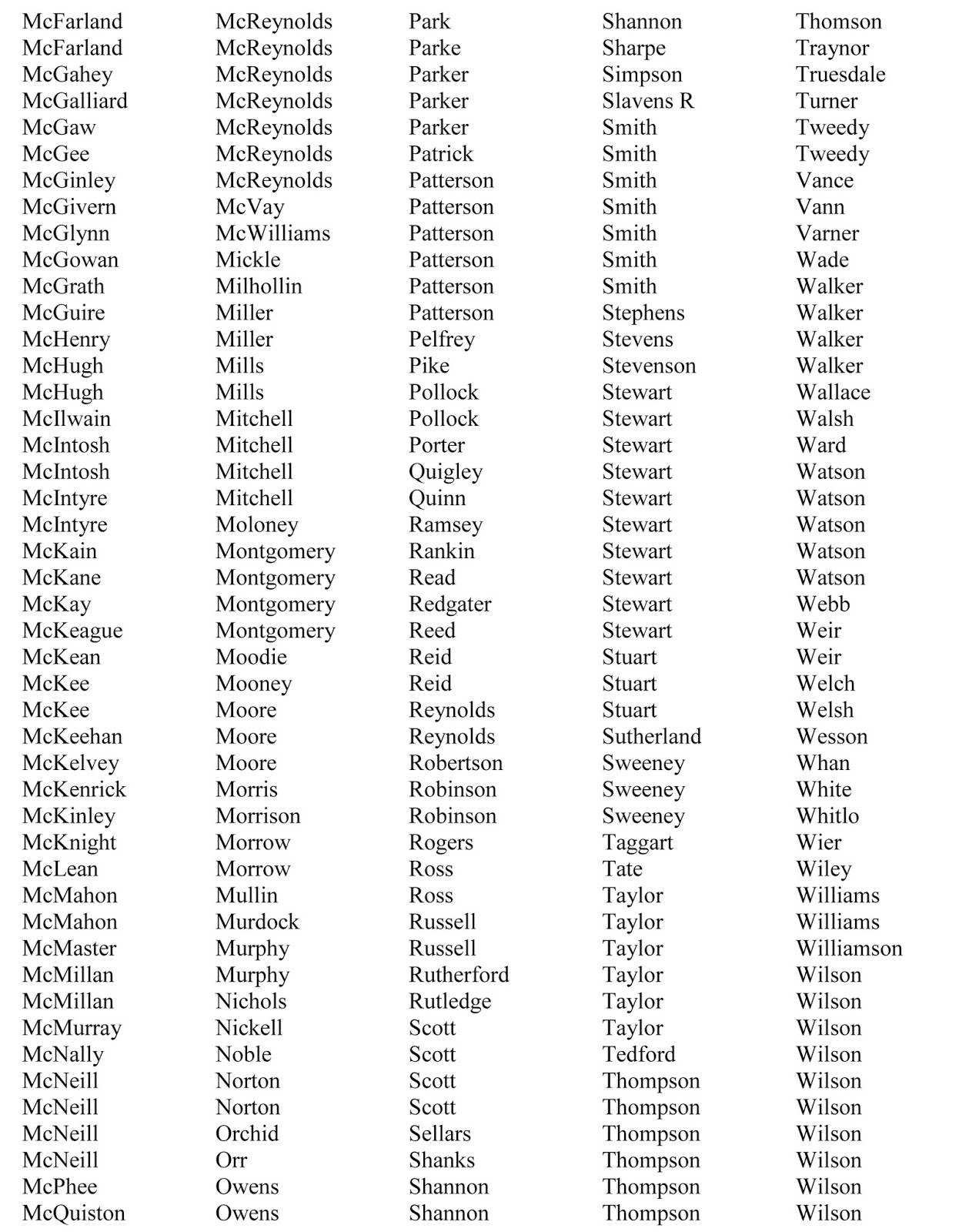
The Scots-Irish DNA Project now has 761 participating families. Below is a roster of the participating families. As you can see the families are a combination of Lowland and Highland Scottish surnames with a few native Irish surnames. All these families self identify as being Scots-Irish. Most of these families participated in the 18th Century Ulster Migration to English Colonies and early Republic, or in the 19th Century Ulster migration into Canada.
The majority of the Lowland Scottish families are from Ayrshire, Lanarkshire, and Gallowayshire, and most of these families migrated to Ireland during the Ulster Plantation (1609-1720). The Highland Scottish surnames from Argyll, Lennox, and the Southern Hebrides; many of these families migrated to Ulster circa 1550-1600).
The dominate haplogroups are Insular Celts (85%) and there is about 12% of the haplogroups of Norse/Norman ancestry. The native Irish surnames come from certain families that converted to the reformed faith and became part of the Protestant Irish community in the 1600s.
Click on image to enlarge:



Saturday, June 20, 2015
McCain's Corner: Autosomal DNA Test Sale
McCain's Corner: Autosomal DNA Test Sale: Autosomal DNA tests utilize DNA from the 22 pairs of autosomal chromosomes. Autosomal DNA is inherited from both parents. Ther...
Wednesday, May 20, 2015
Foyle Valley Covenanters, a new book by William Roulston

Dr William Roulston is the Research Director of the Ulster Historical Foundation. He holds a PhD in Archaeology from Queen’s University Belfast.
Foyle Valley Covenanters
In the middle of the eighteenth century a community of Covenanters in the Foyle Valley emerged from the shadows to form a congregation. The first minister was ordained in 1765 and six years later a site at Bready was secured for a meeting house. Since then the members of this small but significant congregation have been active in preserving a Reformed Presbyterian witness in the district as well as contributing to many other aspects of local life. Through a detailed study of the congregational and denominational records, this book explores the ministers and ministries, the life and work of the congregation, the buildings, the families, and the relationship between the Covenanters of Bready and the state. The appendices to the book include an index to the names in the earliest session book (1791-1800). Raised on the family farm in Bready, William J. Roulston grew up a few fields away from the Covenanter meeting house. He has written extensively on his local area and is the convener of the Reformed Presbyterian Church History Committee.
For overseas orders the best place to go is:
Ulster Heritage Magazine: Gaelic Language Festival 26-28 June in Ontario
Ulster Heritage Magazine: Gaelic Language Festival 26-28 June in Ontario: OIREACHTAS GAEILGE CHEANADA A Festival of Gaelic Language and Culture 26 – 28 June 2015 Register Now Information ...
Sunday, May 17, 2015
McCain's Corner: Gaelic Female Ancestor Names pre 1600 in Genetic G...
McCain's Corner: Gaelic Female Ancestor Names pre 1600 in Genetic G...: As you progress with your genetic genealogy research you will eventually reach a point where records were not written in modern E...
Saturday, April 25, 2015
McCain's Corner: DNA Match Group & Derbhfine Names
McCain's Corner: DNA Match Group & Derbhfine Names: If your Y-DNA match group has developed a strong geographic pattern this will allow you to research the primary sources of that locatio...
Thursday, April 23, 2015
Scots-Irish DNA Project Update 23 April 2015

For members interested in a case study of a Family Tree DNA family
project that located their cousins in Ulster and eventually located
their progenitor in Argyll, Scotland, we suggest the new book 'Finding the McCains' (on Amazon). The book shows how a Y-DNA match group can
be used to focus research on specific geographic area and the use of the
primary sources there. It is a familiar tale to many researchers. A
40 year search for family history, the brick wall, then the DNA testing
with dramatic results. It can be a complex task, but it can be done and
'Finding the McCains' is an excellent example of how one Ulster family
accomplished this. The McCains include Senator John McCain, the
Canadian family of Wallace and Harrison McCain of New Brunswick, and
James McKeen, co-leader of the 1718 Ulster fleet that began the Ulster
migration.
I have received several emails concerning ‘genetic convergence’ which can produce a false match: There was a rapid population expansion in the last 4000-5000 years and some of the lineages within R1b1a2 have experienced convergence of STR values. This is due to the random mutation process. Some of the more distant lineages have moved closer together producing coincidental matching haplotypes. This phenomenon is called “convergence” (also known as evolutionary convergence) is the term we use in genetic genealogy to describe the process when two different haplotypes mutate over time to become identical or near identical resulting in an coincidental match. Coincidental matches will often be in different subclades and the common ancestor will have lived several thousand years ago rather than within a genealogical timeframe. A convergence can produce a “false positive" match.
This is one reason we recommend you test at least 67 markers. There has been only one case of a convergence match at this level. The 111 marker level is the best test to filter out any possible convergence match. This is particularly important for participants Ulster and Scottish ancestry, because surnames were often not fixed until very late, circa 1500 to 1700. In many cases your non-surname matches are just important as your surname matches, but only if they are bona fide matches. In our geographic area many clans and families used different surnames as these groups followed patronymic naming customs. An example of this: a Mac Dónaill family circa 1520 has an illustrious son named Alastair and by 1570 his line uses the surname Mac Alastair. When a descendant tests he will find anglicized forms of both Mac Dónaill and Mac Alastair present in his match group. In this example the match group could contain numerous anglicized forms, Alexander, Alastair, Daniels, Donaldson, McDaniels, McDonald, McDonnell, etc.
I have received several emails concerning ‘genetic convergence’ which can produce a false match: There was a rapid population expansion in the last 4000-5000 years and some of the lineages within R1b1a2 have experienced convergence of STR values. This is due to the random mutation process. Some of the more distant lineages have moved closer together producing coincidental matching haplotypes. This phenomenon is called “convergence” (also known as evolutionary convergence) is the term we use in genetic genealogy to describe the process when two different haplotypes mutate over time to become identical or near identical resulting in an coincidental match. Coincidental matches will often be in different subclades and the common ancestor will have lived several thousand years ago rather than within a genealogical timeframe. A convergence can produce a “false positive" match.
This is one reason we recommend you test at least 67 markers. There has been only one case of a convergence match at this level. The 111 marker level is the best test to filter out any possible convergence match. This is particularly important for participants Ulster and Scottish ancestry, because surnames were often not fixed until very late, circa 1500 to 1700. In many cases your non-surname matches are just important as your surname matches, but only if they are bona fide matches. In our geographic area many clans and families used different surnames as these groups followed patronymic naming customs. An example of this: a Mac Dónaill family circa 1520 has an illustrious son named Alastair and by 1570 his line uses the surname Mac Alastair. When a descendant tests he will find anglicized forms of both Mac Dónaill and Mac Alastair present in his match group. In this example the match group could contain numerous anglicized forms, Alexander, Alastair, Daniels, Donaldson, McDaniels, McDonald, McDonnell, etc.
Address for our blog below; news of the project is posted there. Best of luck with your genetic genealogy project.
http://thescotsirish.blogspot.com/ (The Scots-Irish Blog)
--
McCain's Corner: http://barryrmccain.blogspot.com/
Ulster Heritage: http://uhblog.ulsterheritage.com/p/books.html
Barry R McCain website: http://www.barryrmccain.com/
Monday, April 6, 2015
Ulster Heritage Magazine: Books
Ulster Heritage Magazine: Books: Finding the McCains Finding the McCains , is an account of a man’s 40 year odyssey to find the McCain family in Ireland. Senator Jo...
Friday, April 3, 2015
Ulster Heritage Magazine: Y-DNA testing... When No Paternal Relative Is Avai...
Ulster Heritage Magazine: Y-DNA testing... When No Paternal Relative Is Avai...: Y-DNA test When No Paternal Relative Is Available A frequent issue in genetic genealogy is the problem of Y chromosome DNA testing when...
Monday, March 30, 2015
McCain's Corner: Irish and Scottish Clan Surnames
McCain's Corner: Irish and Scottish Clan Surnames: Clan Surnames Many people with Gaelic origin surnames are interested in researching their clan connections. This is cannot be...
Sunday, March 29, 2015
McCain's Corner: Genetic Genealogy of Irish, Scots, and Scots-Irish...
McCain's Corner: Genetic Genealogy of Irish, Scots, and Scots-Irish...: There are several firms that do DNA testing for individuals and groups doing genealogical research as well as research concerning ethnicity...
Sunday, March 1, 2015
The Kilt and the Scots-Irish
(note many Scots-Irish are of Argyll and Lennox ancestry, areas where the kilt was worn. Of interest, the first detailed record of the kilt in use is from Ireland; an account of Redshanks arrived in 1596)
Is the kilt Irish…. was the kilt ever worn in Ireland? The answer to this question is a very simple yes, of course, but even simple answers need some explanation. The kilt comes in two forms, the filleadh beag and the filleadh mór. The wearing of kilts came into fashion in the Hebrides and Highlands of Scotland sometime during the late 1500s. Prior to the popularsation of the kilt most Isles and Highlanders dressed identical to the native Irish in a léine and short jacket.
 Liam Neeson portraying Rob Roy wearing the large kilt, of filleadh mór
Why the kilt came into fashion can only be speculated on, perhaps it was the changing climate, which was growing colder in the late 1500s and the full kilt offered warmth, or perhaps it was improved small looms that could produce more woolen cloth, or perhaps just a fashion trend indigenous to the Gaels of Scotland. For whatever reason, the kilt became popular and fashionable among Gaels in certain parts of Scotland and would be brought to Ireland by Scottish Gaels that settled there in the late 1500s.
The filleadh mór is comprised of a very long piece of material called a plaid, which is belted in the middle. The upper part could be arranged in various ways depending upon the temperature of the day. The part below the belt was folded in the back to make pleats and came down to the knees.
There is a pseudo history about the creation of the smaller kilt, the filleadh beag, which is the form of kilt still very much in use today. At some point prior to 1690s, Gaelic tailors began to cut the filleadh mór in half. It was an organic fashion development within the Scottish Gaelic community. The upper part became a separate plaid and the lower part had the folds sown into it. This way the lower half, the kilt, could be worn separately from the plaid.

Sean Connery wearing the small kilt, or filleadh beag
A false story has long circulated about the creation of the small kilt that maintained two English tailors invented this form in 1727. However, in Gaelic oral history it was known that the small kilt predates this time. The English creation myth persisted in some circles until writer Clifford Smyth produced an illustration of the small kilt in use in 1690 and put an end to the pseudo history of the small kilt.

18th Century illustration on how to wear the kilt
In Ireland the full kilt and small kilt were worn in those areas settled by Highland and Hebridean Gaels. There are eyewitness descriptions of the kilt being worn as early as the 1590s in Ulster. Originally it was worn in the Redshank communities in east Donegal, northwest Tyrone, and north Antrim. Its popularity has waxed and waned over the years, but more and more the small kilt can be seen in Ireland worn at weddings and parties, by hill walkers, and sportsmen. This growing popularity of this very old Gaelic garment is natural and part of the heritage of Ulster.
Thursday, February 26, 2015
Finding the McCains
The remarkable story of the McCain family from Ulster, their ranks include James McKeen, co-leader of the 1718 fleet and first magistrate of the Londonderry, NH, settlement, Wallace and Harrison McCain of McCain Foods, Ltd., Admiral John Sydney (Slew) McCain, and Senator John McCain.

To purchase from Amazon: Finding the McCains
To purchase from Ulster Heritage directly send US $20 (postage paid) to:
Ulster Heritage
PO Box 884
Oxford MS 38655
USA
Finding the McCains
Finding the McCains, is an account of a man’s 40 year odyssey to find the McCain family in Ireland. Senator John McCain and his cousin, novelist Elizabeth Spencer, both include a short history of the McCain family in their respective memoirs Faith of our Fathers and Landscapes of the Heart. Their history is a romantic tale of Highland Scots who supported Mary Queen of Scots and who fled to Ireland after her downfall in 1568. The search for the McCains became a mystery story with clues, false turns, many adventures, and then ultimate success through Y chromosome DNA testing. In 2008 the McCains were reunited with their family that remained in Ireland, after 289 years of separation.
The McCain history includes people and events familiar to readers of Irish and Scottish history; Redshanks, Iníon Dubh, Mary Queen of Scots, the Earls of Argyll, the Ulster Migration, and the Scots-Irish, are all part of this family’s history. Faint memories of this past were told for generations in Mississippi and as the research progressed the facts behind these memories were uncovered.
The Y chromosome DNA results revealed that the McCains of Mississippi, which include Senator John McCain’s family, are the same family of Wallace and Harrison McCain, the founders of Canada’s McCain Foods, one of the most successful corporations in the world. They are also the same family as James McKeen who organized the 1718 fleet that began the great Ulster Migration to the English Colonies. All these families are paternally related and they all descend from one Gaelic man named Mac Eáin that lived in Kilmichael Glassary parish, in mid Argyll, in the Scottish Highlands, in the 1400s.
The book tells of the author’s many trips to Ireland in search of his distant cousins there. There are anecdotal stories, some humorous and others involving “famous” people; such as, Phil Robertson of Duck Dynasty, Mary Coughlan (Irish Tainste or vice president), Cindy McCain (wife of Senator McCain), Seán Mac Stiofáin (1970s head of the IRA) , Alan Heusaff (WW II German officer in Dublin who later became president of the Celtic League), and Muhammad Ali. There is even an encounter with a Bean Sí (faerie woman) on the windy cold hill of megalithic stone ruins at Loch an Craoibh. All presented from the perspective of a native Mississippian.
Another theme in the book is the Scots-Irish. Contemporary histories about the Scots-Irish present stereotyped and romanticized accounts of this dynamic group. Finding the McCains reveals a more complex history and shows the cultural conflation common in Scots-Irish popular history.
Finding the McCains is an excellent read for all interested in Irish and Scottish history and is an how-to guide for those interested in how-to guide for those who would like to use genetic genealogy to locate their family in the old country and recover lost family history.
To purchase from Amazon: Finding the McCains
To purchase from Ulster Heritage directly send US $20 (postage paid) to:
Ulster Heritage
PO Box 884
Oxford MS 38655
USA
Wednesday, February 18, 2015
Haplogroup R-S1051 Project
(Many Scots-Irish are in R-S1051 haplogroup. A lot of research going on with this haplogroup; they appear to be indigenous to central Scotland. Those men that have the R-S1051 haplogroup are encouraged to participate in the research. One can join by using your 'manage projects' link on your Family Tree DNA page.)
Recently many new SNP's have been discovered for this unique haplogroup which is located below DF13.
The majority of this family group have 5 main Patriarch SNP's (S1051, FGC9655, FGC9661, FGC9658 and FGC9657). The current age estimate for these Patriarch SNP's is approximately 3,200 to 4,500 years old and likely originated within what is known as the Bell Beaker culture. When examining other haplogroups of a similar age the S1051 people are very few by comparison
.
Evidence suggests that the geographic origin of this family group could have been from what is now modern Scotland.
https://www.familytreedna.com/public/R-S1051/default.aspx?section=results
S1051 Project SNP results spreadsheet page 1 of 2.
https://docs.google.com/spreadsheets/d/1E1iiiFeUgXGA-Trg_whSqbK_sTZI5csja4dRFWZ5-bE/edit?usp=sharing
S1051 Project SNP results spreadsheet page 2 of 2 - FGC17906+
https://docs.google.com/spreadsheets/d/1YsOmg_EaoSh3QVKn9u_216ZtN3nI8LO5-NRA5Oscg4s/edit?usp=sharing
On the above spreadsheet links I've placed "SNP dates" which are an approximation as these mutation rates can vary. So far on average there is 1 Sanger SNP verified per 139 years so it's important to stress that these dates could change slightly as more research needs to be completed. There are instances like the single defining McCeney SNP which likely exceeds 200 years since it's mutation and other examples which were fewer than 139 years. Other factors to consider are the number of SNP's captured from the various sequencing types and the number of raw SNP's which are culled due to reliability issues. The age estimate 139 years per SNP was calculated by using known genealogy, full Y testing, Sanger verification, STR calculations and averaging the number of raw SNP's located below DF13. It's also important to understand that chronology of many of the SNP's (including the 5 main oldest ones) are still unknown.
The following link is to a 64 page paper written by Ronald Henderson that I recently discovered online. Although some concepts found within may stir debate within the historical or scientific community I believe it was well written and worth adding to project page.
http://www.thesonsofscotland.co.uk/Rex%20Pictorum.pdf
Link: R-S1051 Project
Recently many new SNP's have been discovered for this unique haplogroup which is located below DF13.
The majority of this family group have 5 main Patriarch SNP's (S1051, FGC9655, FGC9661, FGC9658 and FGC9657). The current age estimate for these Patriarch SNP's is approximately 3,200 to 4,500 years old and likely originated within what is known as the Bell Beaker culture. When examining other haplogroups of a similar age the S1051 people are very few by comparison
.
Evidence suggests that the geographic origin of this family group could have been from what is now modern Scotland.
https://www.familytreedna.com/public/R-S1051/default.aspx?section=results
S1051 Project SNP results spreadsheet page 1 of 2.
https://docs.google.com/spreadsheets/d/1E1iiiFeUgXGA-Trg_whSqbK_sTZI5csja4dRFWZ5-bE/edit?usp=sharing
S1051 Project SNP results spreadsheet page 2 of 2 - FGC17906+
https://docs.google.com/spreadsheets/d/1YsOmg_EaoSh3QVKn9u_216ZtN3nI8LO5-NRA5Oscg4s/edit?usp=sharing
On the above spreadsheet links I've placed "SNP dates" which are an approximation as these mutation rates can vary. So far on average there is 1 Sanger SNP verified per 139 years so it's important to stress that these dates could change slightly as more research needs to be completed. There are instances like the single defining McCeney SNP which likely exceeds 200 years since it's mutation and other examples which were fewer than 139 years. Other factors to consider are the number of SNP's captured from the various sequencing types and the number of raw SNP's which are culled due to reliability issues. The age estimate 139 years per SNP was calculated by using known genealogy, full Y testing, Sanger verification, STR calculations and averaging the number of raw SNP's located below DF13. It's also important to understand that chronology of many of the SNP's (including the 5 main oldest ones) are still unknown.
The following link is to a 64 page paper written by Ronald Henderson that I recently discovered online. Although some concepts found within may stir debate within the historical or scientific community I believe it was well written and worth adding to project page.
http://www.thesonsofscotland.co.uk/Rex%20Pictorum.pdf
Link: R-S1051 Project
Monday, February 16, 2015
Native Tribes of Britain
The majority of the Scots-Irish are descendants of the native Celtic tribes of north Britain. Here is a link to an article on the BBC History website showing the location and names of these early Celtic tribes.
Link: Native Tribes of Britain
Link: Native Tribes of Britain
Tuesday, February 3, 2015
The Tweedy Family: Tweedys in Scotland and Ireland
The Tweedy Family: Tweedys in Scotland and Ireland: We need Tweedys (by any spelling) to participate in DNA testing. Our goals are to locate the Tweedy family in Scotland and Ireland and reco...
Wednesday, January 28, 2015
The Highland Scots in West Ulster
Amazon is running a sale on the book 'The Laggan Redshanks.' The sale price is only US $13.46. The book tells the fascinating story of the Highland Scottish migration to Donegal in the 1500s. Many of these Highlanders migrated to the Colonies in the 1700s and became 'Scots-Irish.'

In the sixteenth century Scottish Highlanders settled in the Laggan district of east Donegal. They were called Redshanks. The history of the Laggan Redshanks has many fascinating elements which include Clann Chaimbeul and their dynamic leader the fifth Earl of Argyll, Gaelic sexual intrigues, English Machiavellian manoeuvres, and the Redshanks themselves. This book not only tells the fascinating story of how a Highland Scottish community became established in the Laggan, but also includes the surnames of the Redshanks and notes of their origins in Scotland, which will be of interest to family historians and genealogists.
Link to purchase: The Laggan Redshanks
Saturday, January 10, 2015
Scots-Irish, Genetically Speaking
The Scots-Irish were descendants of Scottish settlers in Ireland. Many of these Scottish settlers were in turn descendants of Lowland Scots that settled in Ulster circa 1609 to the early 1700s. Others were descendants of Highland Scots from Argyll, the southern Hebrides, and Lennox, that settled in Ulster during the 1500s. Both of these groups in turn were the descendants of the various Celtic groups indigenous to what is now Scotland. Recent DNA testing has revealed that the dominated DNA haplogroups of the Scots-Irish are R-M222 and R-L21. Below are illustrations that show the geographic locations of these two haplogroups.
 |
| map showing highest concentration of R-M222 |
 |
| maps showing highest concentration of R-L21 |
Wednesday, December 10, 2014
Ulster Heritage Magazine: Christma Sale on DNA testing from Family Tree
Ulster Heritage Magazine: Christma Sale on DNA testing from Family Tree: Link to join: Ulster Heritage DNA Project
Monday, November 17, 2014
Tim Clarkson & Viking Age Strathclyde

Tim Clarkson's new book on Viking Age Strathclyde is now available and highly recommended.
Strathclyde and the Anglo-Saxons in the Viking Age traces the history of relations between the Cumbri or North Britons and their English neighbours through the eighth to eleventh centuries AD. It looks at the wars, treaties and other high-level dealings that characterised this volatile relationship. Woven into the story are the policies and ambitions of other powers, most notably the Scots and Vikings, with whom both the North Britons and Anglo-Saxons were variously in alliance or at war.
As well as presenting a narrative history of the kingdom of Strathclyde, this book also discusses the names ‘Cumbria’ and ‘Cumberland’, both of which now refer to parts of north-west England. The origins of these names, and their meanings to people who lived in Viking-Age Britain, are examined and explained.
The book’s main contents are as follows:
Chapter 1 – Cumbrians and Anglo-Saxons
A discussion of terminology and sources.
Chapter 2 – Early Contacts
Relations between the Clyde Britons and the English in pre-Viking times (sixth to eighth centuries AD).
Chapter 3 – Raiders and Settlers
The arrival of the Vikings in northern Britain, the destruction of Alt Clut and the beginning of the kingdom of Strathclyde or Cumbria.
Chapter 4 – Strathclyde and Wessex
Contacts between the ‘kings of the Cumbrians’ and the family of Alfred the Great.
Chapter 5 – Athelstan
The period 924 to 939 in which the ambitions of a powerful English king clashed with those of his Celtic and Scandinavian neighbours. Includes a discussion of the Battle of Brunanburh.
Chapter 6 – King Dunmail
The reign of Dyfnwal, king of Strathclyde (c.940-970) and the English invasion of ‘Cumberland’ in 945.
Chapter 7 – The Late Tenth Century
Strathclyde’s relations with the kings of England in the last decades of the first millennium.
Chapter 8 – Borderlands
The earls of Bamburgh and their dealings with the kings of Alba and Strathclyde. Includes a discussion of the Battle of Carham (1018).
Chapter 9 – The Fall of Strathclyde
The shadowy period around the mid-eleventh century when the last kingdom of the North Britons was finally conquered.
Chapter 10 – The Anglo-Norman Period
Anglo-Scottish relations in the early twelfth century and the origin of the English county of Cumberland.
Chapter 11 – Conclusions
Notes for each chapter direct the reader to a bibliography of primary and secondary sources. Illustrations include maps, photographs and genealogical tables.
Published by Birlinn of Edinburgh, under the John Donald imprint, and available from Amazon UK and Amazon USA.
Monday, October 27, 2014
The Cracker
 |
| Cracker Cattle |
What is the etymology of the term Cracker? We all know what a Cracker was (or is). A Southern Anglo-Celt, usually of Scots-Irish
origin, who lives in the backcountry.
The term appears intact and in use by the mid-1700s in Colonial America.
One eighteenth-century definition of
what a Cracker provides a good description; in 1776 a Colonial
official wrote to the earl of Dartmouth:
I should explain to your Lordship what is meant by
Crackers, a name they have got from being great boasters; they are a lawless
set of rascals on the frontiers of Virginia, Maryland, the Carolinas, and
Georgia, who often change their place of abode.
They were basically a semi nomadic group who were excellent
hunters, kept free range cattle and pigs, and lived in the backcountry. They were normally of Ulster ancestry, but
not exclusively so.
Cracker is still a much used term. Dubious sources, such as Wikipedia, tell us
it is a “usually derogatory term for white people.” Wikipedia also offers a
proposed etymology of the term coming from the sound of the “whips” used by
Southern whites on their livestock.
The real story is more complex. It is term with links to Ulster and
associated with the people we know as the Scots-Irish. The original Crackers are also associated
with free range cattle and lived in the backcountry. That much is on firm ground, but the
etymology is more difficult to deduce, but I believe is also linked to
Ulster. There are several possible origins, which I will not list
and state each one’s case.
Creachadóir: This is
the word I believe is the actual origin of Cracker. It is Ulster Gaelic and
Scots Gaelic (Creachadair) word meaning, “raider and freebooter,” but also
associated with the free range cattle drovers in Ulster. In short, I think Cracker is the anglicised
form of Creachadóir.
Creach: (Ulster Gaelic) means a “herd of cattle,” and also a “Cattle
raid.” You will also find the word
Greigh in Scot Gaelic meaning a “herd of cattle.” There is also the Scots-Gaelic word
Gréighear meaning a “farm grieve.”
(someone who took care of livestock)
Other possible etymologies:
Cracaire: This word means “talker” or a person that chats a
lot and is related to the modern Irish word “Craic” meaning “a gathering where
people talk, have refreshments, and have a good time.” As far as I can tell, the use of Cracaire and
Craic are more recent in their use in the Gaelic language and I do not think
this is the etymology of Cracker, but it is a debatable point.
I think the salient element is the linking of Crackers to
cattle. Creach was anglicised as Creacht
and was used from the mid-1500s into the early 1800s to describe both a herd of cattle
and the drovers (cowboys) of the herd.
These men were also used for raiding parties. So in actual use a Creacht was both a free
range cowboy and raider and freebooter. In modern Gaelic usage the older
meaning of free range cowboy has been dropped and now the definition is “raider
and freebooter, ” but it was the same thing, or person, in a historical
context. So, in Ulster, we have the word
Creach and Creacht in use in both Hiberno-English and Gaelic and meaning exactly what
the Southern Crackers were. Given the fact that the Crackers were from Ulster and were free range cowboys the Creach, Creacht, and Creachadóir, origin from Cracker is logical.
 |
| A Cracker Cowboy by Frederic Remington |
The anglicised form may be from Creachadóir or it could
be from Creach and anglicised from adding an English suffix of “er.” I think however, the former more
likely.
So, the likely etymology of Cracker is from the Ulster
and Scots Gaelic word Creachadóir. For
the record, Cracker is not considered derogatory among the Crackers living in
the South today. The opposite is true,
it is an often used term of ethnic self-description and is a source of pride. It means you are indigenous to the South,
ancestors from Ulster or northwest Britain, have roots in the Uplands or
Backcountry, are independent, self-reliant, you act in an honorable way, are
good with weapons, hunting, fishing, and are man that knows how to do things. As the Southern Crackers settled Texas and the
Southwest they became the Cowboy, a cultural continuum of their unique
lifestyle.
 |
| Cowboy 1888 |
Thursday, October 23, 2014
AncestryDNA and 23andMe (V3) transfer offer from Family Tree
(additional information of the transfer offer from Family Tree to people who test with AncestryDNA and 23andMe)
Family Tree DNA is now allowing people that have taken an AncestryDNA™ or 23andMe© (V3) test to transfer their raw data to the Family Finder database for FREE by visiting www.familytreedna.com/
You can unlock ALL of your matches and myOrigins results for free by recruiting 4 other relatives or friends to transfer their results using a link we’ll provide!
Family Tree DNA is now allowing people that have taken an AncestryDNA™ or 23andMe© (V3) test to transfer their raw data to the Family Finder database for FREE by visiting www.familytreedna.com/
That’s right! Pass this news along to your friends and family members that have tested with Ancestry.com or 23andMe so they can discover new matches in the world’s largest genetic genealogy database for FREE!
Note: Autosomal raw data cannot be transferred to an account that already has Family Finder
What’s in it for You?
After transferring, you’ll get your top 20 matches, complete with their surnames and relationship predictions. You don’t have to do anything after uploading your data to see these matches. You’ve got nothing to lose!
You can unlock ALL of your matches and myOrigins results for free by recruiting 4 other relatives or friends to transfer their results using a link we’ll provide!
|

|
|

Ulster Heritage Magazine: Transfer your 23andMe©(V3) or AncestryDNA™
Family Tree DNA is offering free transfers from 23andMe and AncestryDNA. This is an excellent opportunity to upload your existed data into Family Tree's data base.
Link: 23andMeV3 and AncestryDNA Transfers
Link: 23andMeV3 and AncestryDNA Transfers
Tuesday, October 21, 2014
Scots-Irish DNA Project Update 21 October 2014
Scots-Irish DNA project update 21 October 2014
The Scots-Irish DNA project has 504 participants as of this date. Family Tree has added many new haplogroups and our project is now updated to include this. The many new haplogroups are downstream from the major designations and represent more recent genetic mutations. Many of the new haplogroups are linked to geographic locations. The research is so new it is hard to post news of them as the data is still coming in. But, eventually, those participants that have done extensive SNP testing should gain a much better understanding of their family's point of origin.
Some notes: non-surname matches are very important at the 67 and 111 levels. In parts of Scotland surnames were not fixed until the 1600s and creation of new surnames from nicknames, aliases, or clan based surnames was common. I have even observed several adoption of maternal surnames in paternal lines that married prominent women from another clan. An example of a nickname being turned into a surname, Seamus Mac Dónaill Glass (the grey McDonald) living early 1700s and his sons just being known as the 'Gray' family.
One key to successful family research is observing geographic clues. Look at the "Paternal Ancestor Names" of your match group for any geographic information. The reason this is some important, families were in general very static and tending to stay in the same area of centuries. Even among the Ulster Scots, this would be true in Scotland and then after migration to Ireland, they tended to stay in the district they initially settled. This pattern changed after the industrial age, but still there is general a cluster of matches where the family initially settled.
If you locate a geographic point of interest, you will want to look at the primary sources for that area. Often you will find your surname, or some variation of it, at that location. Some very good records for Scots-Irish families are the 1630 and 1642 muster rolls. There function as a type a census as each family was expected to have their able bodied men report to the muster.
The Scots-Irish DNA project has 504 participants as of this date. Family Tree has added many new haplogroups and our project is now updated to include this. The many new haplogroups are downstream from the major designations and represent more recent genetic mutations. Many of the new haplogroups are linked to geographic locations. The research is so new it is hard to post news of them as the data is still coming in. But, eventually, those participants that have done extensive SNP testing should gain a much better understanding of their family's point of origin.
Some notes: non-surname matches are very important at the 67 and 111 levels. In parts of Scotland surnames were not fixed until the 1600s and creation of new surnames from nicknames, aliases, or clan based surnames was common. I have even observed several adoption of maternal surnames in paternal lines that married prominent women from another clan. An example of a nickname being turned into a surname, Seamus Mac Dónaill Glass (the grey McDonald) living early 1700s and his sons just being known as the 'Gray' family.
One key to successful family research is observing geographic clues. Look at the "Paternal Ancestor Names" of your match group for any geographic information. The reason this is some important, families were in general very static and tending to stay in the same area of centuries. Even among the Ulster Scots, this would be true in Scotland and then after migration to Ireland, they tended to stay in the district they initially settled. This pattern changed after the industrial age, but still there is general a cluster of matches where the family initially settled.
If you locate a geographic point of interest, you will want to look at the primary sources for that area. Often you will find your surname, or some variation of it, at that location. Some very good records for Scots-Irish families are the 1630 and 1642 muster rolls. There function as a type a census as each family was expected to have their able bodied men report to the muster.
I also would ask everyone to go on your Family Tree
page in enter your Paternal Ancestor Data. Make sure it is your direct
paternal line (we have some that have enter maternal lines, again, the Y
chromosome follows a man's direct paternal line, it is only passed from father
to son, it cannot go through a maternal line).
If you are interested in your "Ancestral
Origins" make sure you have your 12 and 25 level results turned
on. This will show you your distant match group by geographic
location. The higher the percentage the greater the relevance.
Most of the Scots-Irish participants are descendants of the Insular Celts,
these are the indigenous Celtic tribes of both Highland and Lowland
Scotland. We do have a fair number of Norse/Norman participants, and
the a few haplogroups that are associated with parts of Europe that suggest a
Roman Empire connection or in some cases medieval trading
families.
For those of you with Highland Scot origin, Amazon has the
Ulster Heritage book 'The Laggan Redshanks' on sale at present. This
book concerns the Highland Scots that settled in east Donegal and
northwest Tyrone in the late 1500s. We hope to get out a similar
book on the Highland Scots that settled in north Antrim, which is the other
major source of Highland Scots, or Redshanks as they were called, in Ulster.
Our blog address is:
http://thescotsirish.blogspot.com/ (The
Scots-Irish Blog)
Anyone that has a family history update, interesting Scots-Irish
news, and short articles on Scots-Irish people, society, culture, food, etc.,
are urged to submit to the blog. You may also post news of your own
personal Family Tree surname project. It is an excellent way to get the
word out and encourage men with your surname to test. Many of our
participating families have located their cousins in Ireland and Scotland by
"getting the word out."
The best of luck with your research.
Monday, October 13, 2014
R-L21 Haplogroup and the Scots-Irish

Subscribe to:
Posts (Atom)